
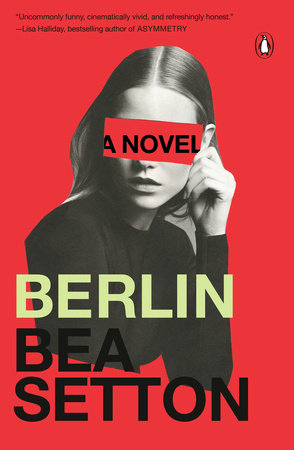
Traveling to a new city can be overwhelming, but moving to a new city without telling anyone, ditching your roommate and cat in London, and turning into a compulsive liar is another! Meet Daphne Ferber, the protagonist in Bea Setton’s debut, Berlin: A Novel, who takes what we would call a leap of faith and allows it to unfold into a rather unhealthy move when she arrives in Berlin. With nowhere to live, no job, and no familiar faces, preparation doesn’t exist in her book. On the upside, her parents’ money rests comfortably in her bank account.

Primarily set in the bohemian neighborhood of Kruzberg in Berlin, the city is an escape for Daphne where artists, intellectuals, and those looking to reinvent themselves land. Its vibrant nightlife, numerous cafes, and deep-rooted history is the Berlin she knows will lead her through this new chapter. Yet amid Berlin’s beauty, a series of troubling events quickly shifts the glimmering narrative. Told in first-person, Daphne grows into an unreliable narrator attached to a disturbing past that quickly shifted my mindset of her from someone delusional to someone deeply suffering with the image of herself. Her unreliability made it fascinating to follow her habits, connect the dots of mysterious events, and figure out if she is lying for her own sake.
Below, I have picked the top 10 places that can guide you around Berlin based on Bea Setton’s novel and Daphne’s adventures and daily routines…
Berlin Travel Guide
To start, Spätkauf, or Spati’s, are one of Germany’s convenience store treasures unique to the city. In Berlin, Daphne seeks great comfort in a Spati that sells anything from toilet paper to tobacco to milk due to the friendly nature it has for tourists or those new to the city who speak minimal German. Often run by Turkish immigrants, the Spati is a place where Daphne becomes familiar with the owner and his two daughters, who provide care towards her when she is at one of her lowest points. If visiting Berlin, you’re bound to end up in a Spati due to their flexible hours and convenience around the city! It’s also a fun and easy way to integrate into German culture by checking out snacks and drinks unique to the country.
To encounter a “beautiful nineteenth-century covered market” (p. 77), the Markthelle Neun is a hub of cultural foods, practices, and crafts. It is only one of two markets in Berlin to survive WWII. Not only is it a historic monument but also a gorgeous opportunity to indulge in cheese, wine, bread, and so much more from experts who travel from all over Europe to share their delicacies.
The Tempelhofer Feld is mentioned numerous times throughout the novel. Famous for being Berlin’s largest open-air space, this field is often the center of exercise, clarity, romantic and unromantic dates, and friendship for Daphne as she grows accustomed to the city. With a multitude of events held here such as sports competitions, theater performances, and walkable trails, it’s a beautiful space to enjoy the weather with good company. Some of the most jaw-dropping sunsets and sunrises can be seen here. “The sky loomed low and close, a lovely dense proton-blue above me, weakening to the white horizon” (p. 38). Daphne’s runs often took place during early mornings on the field, so I recommend visitors go early for the best views and minimal people to experience this former airfield like she does.
The Şehitlik Mosque is where the end of the beginning erupts in the novel, making it an important spot when Daphne’s actions catch up to her. Described as “a beautiful Ottoman-style dome flaked by two tall minarets” (p. 225), this mosque is open for guided tours and a must see for those who adore architecture. Located right by the Tempelhofer Feld, it’s super easy to incorporate into your sightseeing and their outdoor drinking fountain is perfect to stop for a sip after strolling the field.
Checkpoint Charlie is one of Berlin’s biggest historical museums! It’s a long-standing symbol of freedom. The street outside was the location for checkpoints and crossings between East and West Berlin, where the U.S. and Soviet Union were an arm’s length away from beginning a war due to conflicting emotions surrounding the permission of crossing borders. In the novel, Daphne visits this site, finally facing the reality of Berlin’s past. It’s an important point in the novel that contrasts the tourist reality versus the locals, exploring themes of disconnection and modern life. Take that as a lesson to immerse yourself in the complex history of Berlin and to witness the evolution of the city and country as a whole!
On Daphne’s tourist day, she stops at the Memorial to the Murdered Jews of Europe, a site that honors and explores victims of the Holocaust across 1900 square meters through various photographs, monuments, diaries, and farewell letters. With 2,710 concrete slabs of varying heights and rotations, it’s a maze and symbol of the experiences Jews faced during the Holocaust. The moment in the novel is representative of Daphne’s disconnect from reality and it’s a grounding moment that allows her to engage more with what Berlin has to offer.
East Side Gallery is a 1316 meter-long open-air art gallery on a continuous section where the Berlin Wall still exists. Often showcasing political changes and controversial topics explored through art, it is where anyone can pitch ideas for new pieces! The novel touches various political issues such as female safety, drug addiction, and unhealthy relationships related directly to the Berlin scene. The wall as a political symbol has at one point in time explored these themes through artwork!
“A Roman amphitheater, with rows of wooden benches sloping upward, arranged in a semicircle around a fabric screen, which hangs from an old oak” (p. 148) describes Berlin’s Open Air Cinema, which is located in the park of Hasenheide Freiluftkino. But they host frequent movie showings in multiple parks throughout the city! It’s an important setting in the book not only showcasing the beauty of the Berlin community coming together but also a major plot point built on romance and connection. The showings come from a variety of movies such as classics, indies, and mainstream, so there is truly something for anyone to spend a warm evening outdoors.
Speaking of the arts world, Gendarmenmarkt Square is for music, theater, and literature lovers that offers Open-Air concerts every summer and is home to the poet E.T.A. Hoffmann. You can see his home in a short walk from the square! While not mentioned exclusively in the novel, there is no doubt that basking in the summer warmth surrounded by the beautiful architecture won’t inspire book lovers and expose you to the inspiration of great writers alike.
It wouldn’t be Berlin if you didn’t mention the famed nightlife. The White Rabbit, while not featured in the novel, is one of Berlin’s most popular night clubs. Known for its electric lights and extravagant objects, its two floors of electronic beats represent the chaotic and fun nightlife the city is known for. Daphne never attends any nightclubs, often passing them with moments of regret and major FOMO, but she can’t seem to get there. If you enjoy partying, this place is highly recommended for its various themes, including Fem-Night that features all female DJs and party-goers!
Reflecting on the Novel
If you’ve read Elena Ferrante’s My Brilliant Friend quartet, then you’ll see the parallels between Daphne and Lila. Both are deeply secretive and problematic but unbelievably interesting to read — you just grow to like them despite their flaws, and in many ways it’s their lack of perfection that pulls you in.
On the downside, I felt like Berlin could be slightly repetitive at times as the same problems and men continue to haunt Daphne throughout her trip. “Red herrings and cliffhangers stoke interest by conforming to expectations until the novel undercuts them with digressions and anticlimaxes, reveling in its own formal impunity,” says Jenny Wu from The New York Times. Despite being trapped within Daphne’s fixations, the moments where Berlin is explored make them all the more pleasurable. The city once intended as an escape becomes a nightmare for Daphne yet Berlin’s charm remains undeniable regardless of Daphne’s tension with herself and those around her.
[contact-field default="4" type="rating" label="Rating" labelclasses="wp-block-jetpack-label" labelhiddenbyblockvisibility="" inputclasses="" iconstyle="stars" fieldwrapperclasses="wp-block-jetpack-field-rating"]<div> </div>[/contact-field]I gave Berlin a four-star rating on Goodreads, despite some of its shortcomings because it truly grabbed me until the last page. I just had to know if Daphne was going to pull herself out of her head! At many points in the novel, the writing is charismatic and witty and such a fun analysis of the lies not only men tell on dating apps (which is A LOT) but also how Daphne justifies her own lies. I began to root for her, and I believe many others will!
If you like this book, I would also recommend watching The Worst Person in the World, which explores a young Norwegian woman’s struggle navigating her romantic life and future career journey.
Transparency disclosure: Buying through the book links to Amazon on this site could earn Travel Muse Magazine commission, at no cost to you (it comes out of Amazon’s end). Thanks for helping us maintain this site, while also getting a good book to make your travels better!


Leave a Reply