

Some places feel deeply familiar before you ever set foot in them. For me, Baghdad was always one of those places. Having heard stories from family endlessly, I knew that visiting Baghdad for the first time wasn’t going to be like any other trip. It was vital for me to visit. It would be the only way I could fully come to understand my roots and myself.
The fall of 2022 was when all those stories I grew up hearing were brought to life. For the first time, I got to see the home where my grandmother grew up and where my grandfather attended university. I had spent so much time fantasizing about coming back home, it was hard to believe it actually finally happened. It is home in the sense that it’s really not my home at all, but nowhere truly feels as familiar to me as it does. Having read about the city endlessly might also have contributed to that feeling.
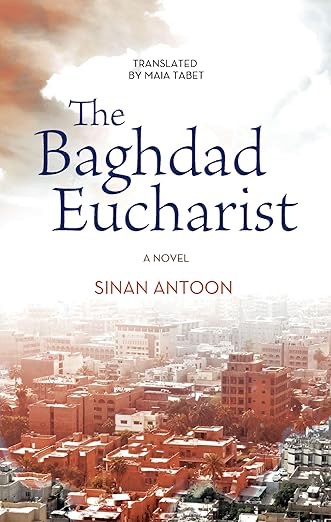
The Baghdad Eucharist by Sinan Antoon was the first book I read that was fully set in the city of Baghdad, offering me an intimate and deep lens that allowed me to better understand the city and its history. The novel follows the lives of two Iraqis living in Baghdad. Maha and Youssef are family but have a wide age gap, which is reflected in how they perceive life within Iraq and its various challenges. What truly stood out to me about the book, while reading it, was how it was able to capture the lives of its characters despite the violence that they were living through. So much of literature based in the Middle East seems to be unable to do so, but the Baghdad Eucharist is truly special in how it is a testament to the resilience of the lives of everyday people living within its city, particularly through its two central characters, Youssef and Maha.
Reading through the book, we are able to see a record of vitally important sites found within Baghdad. This is no small feat, as it is able to help us identify the heart of the city and allows us as readers to better understand how settings play a role in shaping the lives of their characters. This is why I have made a map and guide to Baghdad, highlighting the various locations mentioned in the book and their importance as various heritage sites found within the city.
Sayidat Al-Najat Church is one of the most significant locations connected to the novel, as it is the site of the 2010 attack that inspired the book to begin with. It represents both faith and the resilience of the Iraqi Christian community. In the Baghdad Eucharist, the attack here is an event that is at the emotional core of the narrative, as the church is a powerful reminder to us that the book is rooted in real experiences and tragedy, which I believe makes the novel much more impactful.
Firdos Square is one of the most widely recognized sites in Baghdad, largely known for the toppling of Saddam Hussein’s statue in 2003. This particular moment was broadcast around the world in 2003, and it represented a turning point in modern Iraqi history. In The Baghdad Eucharist, we see how the aftermath of events like these shapes the everyday lives of the people who must bear the burden of changes such as these. The square represents how these political changes are not distant- they directly impact people at every moment in time, and it offers us insight into how these public moments reshape the private lives of people.
Al- Mutanabbi Street is truly the embodiment of Baghdad as a city. There is no place I can think of that better symbolizes the city and its enduring perseverance. A cultural landmark, it is known for its endless rows of books, street vendors, and its deep connection to Iraq’s literary history. Named after the poet Abo Al-Tayeb Al-Mutanabbi, the street has served as a gathering place for writers, readers, and poets for decades. Despite a devastating bombing in 2007, it was rebuilt and now continues to stand as a symbol of the resilience of the Iraqi people and the power of literature. It is mentioned in the Baghdad Eucharist and it reflects the importance of memory and storytelling in the novel.
Shabandar Cafe is one of the oldest and most historic coffeehouses in Baghdad, tucked along Al-Mutanabbi Street and filled with photographs that tell stories of the past. Since opening in 1917 it has been a meeting place for poets, journalists, and academics, making it a central part of Baghdad’s intellectual life. In the same way, we see how The Baghdad Eucharist is built on conversation and reflection, we see through the cafe the very same moments reflected in writing.
Karada Kharji is one of the most well-known and vibrant neighborhoods in Baghdad, located in the city’s central district and recognized for its historically significant Christian population. It has long been a neighborhood where various communities lived side by side, filled with shops, restaurants, and busy streets that reflect the everyday rhythm of life in the city of Baghdad. It is also where the main characters in the book live, making it the central setting of the story. Like much of Baghdad, Karada carries layers of history, culture, and tension all at once. Walking through the neighborhood today, we can feel the resilience of the city and its people, as despite the violence that occured people continue to live, connect, and hold on to their homes there.
Bataween is another one of Baghdad’s oldest neighborhoods, a place that continues to hold onto memories of an old Baghdad even as change comes and goes. Known for its diverse and close-knit communities, including a large population of Jewish and Christian families, it was a vitally important part of the city and what it represents. Over time, though, Bataween has become a reflection of everything Baghdad has gone through: war, displacement, and loss slowly reshaped it, leaving behind a neighborhood that feels like a distant memory. In The Baghdad Eucharist, Bataween connects deeply to this idea of memory, especially for older generations like Youssef’s character, who remember what the city used to be before everything changed. Walking through it today, you can still see glimpses of that past in the architecture and atmosphere, but there’s also a heaviness to it, as if the neighborhood itself remembers.
The Tigris River runs through the center of Baghdad and has been an integral part of the city’s identity for thousands of years. It has witnessed various empires rise and fall, and it continues to flow. But today, due to climate change and political conflict, including dam constructions by neighboring countries, the river faces dropping water levels every day and a risk of drying up completely. Yet, the Tigris is more than just a physical landmark that appears in the book. It represents endurance, as even in the face of violence, it continues to flow. It is deeply symbolic of struggle, not just survival, and the effort it takes to keep moving forward when everything around one is changing.
Near the Tigris is where to go to taste the iconic Iraqi dish masgouf. This is more than a meal in Iraq, it’s an experience that brings people together. Prepared for centuries now, it is the “de facto national dish” of the country, according to the LA Times. Traditionally, the fish is prepared and eaten outdoors with family and friends. Along Abu Nuwas street, the dish continues to be prepared regardless of the conflict. This article highlights some of the best places to get this dish today in Baghdad. Bringing people together every day it is a widely loved and celebrated dish by the people of Iraq. Even if you never make it to Iraq, you can enjoy this dish in the U.S. For example, Al Masgoof Grill in Sterling Heights, Michigan has been reviewed as having an excellent version of this authentic dish, as well as many other places across the U.S. from Chicago to Arizona.
Al- Rasheed Street was once of Baghdad’s most lively and culturally rich areas, filled with theaters, cafes, and social spaces. It represents a time when the city thrived artistically and socially. In the novel, the past is something characters such as Youssef constantly remember and compare to their present reality. Recently, the street has undergone renovations involving, in part, the restoration of older buildings in hopes of reviving these cultural sites to attract tourism. Regardless of how much the renovations change the street, it will continue to reflect a version of Baghdad that still exists in memory.
Al Zawaa Park was once one of the largest and most vibrant zoos in the Middle East, filled with hundreds of animals and families visiting daily. It was a place of life, especially for the children of Baghdad. After the 2003 invasion, it was left nearly destroyed, with only a handful of animals surviving the chaos. Since then, the zoo has slowly been rebuilt, but it still carries the weight of what happened deeply. I found it to reflect the emotional core of the novel as it symbolizes how even in a place meant for escape and happiness, the impact of conflict is carried into nearly every crevice of life.
Qishla Building is an Ottoman-era complex near Mutanabbi Street, which was originally military barracks, and “has become a venue for art events hosted by Iraqi poets, artists, and art lovers.” Known for its clock tower, which is a visual landmark today, it represents the city’s layered history. Culturally, it is also important as it highlights a history of Turkmen communities in Iraq.
Baghdad in The Baghdad Eucharist is more than a setting. It’s a city you can walk through, feel, and experience, from its streets to its neighborhoods to its food and history as well. On a rating out of 5 stars, I would definitely give it 5 stars as it truly is rare to find such well-written pieces of literature that speak to modern-day Iraqi history so brilliantly. If the book seems to interest you, I would recommend reading The Kite Runner, as it explores similar themes of memory. I would definitely recommend reading this book as it is extremely powerful and is a testament to the resilience of various communities across Iraq. As journalist Jane Wallace writes in her review of the book, “the message of this book is that we have to find a way to live together, despite our opinions or choices. Otherwise, brutal chaos ensues.” A vital message to keep in mind, not only while reading the book but also as we continue to navigate the ever-changing conditions of the world we live in and how they affect one another.
Transparency disclosure: Buying through the book links to Amazon on this site could earn Travel Muse Magazine commission, at no cost to you (it comes out of Amazon’s end). Thanks for helping us maintain this site, while also getting a good book to make your travels better!


Leave a Reply