
When I visited Paris, it felt lifeless and full of monuments I forced myself to visit. The Louvre is beautiful and so is the Eiffel Tower and Notre-Dame, but the heart of Paris did not feel like it lived in those places. I left knowing that I had not really visited Paris at all, and I hoped one day I would. Six years after visiting, I found the city in between the pages of A Moveable Feast by Ernest Hemingway. Hemingway makes Paris feel like a hometown. His descriptions of a simple, artistic living are incredibly captivating. That, mixed with stories of famous writers like Gertrude Stein and F. Scott Fitzgerald makes for a book that feels unique, completely capturing 1920s Paris in 200 pages.
A Moveable Feast is a memoir of Hemingway’s time living in Paris with his first wife and child. It follows Hemingway before he has written his first novel, meeting famous writers and describing his own writing process. The book doesn’t follow a traditional story: there is really no driving force other than his own writing. This way of storytelling makes place a central aspect of the book. Since it is being driven by description, a majority of that description is specific to Paris. I have compiled ten places featured in A Moveable Feast that felt important to Hemingway’s time while in Paris that we can visit and relive the city through his eyes.
La Closerie de Lilas
At the top of that list, and arguably the most important place, is La Closerie de Lilas. La Closerie de Lilas is simply described in the book as a “good cafe” (p. 81). But what makes this place especially important, is that everyone with artistic inclination went there. This is also where Hemingway does a lot of the writing for his first novel, The Sun Also Rises. Today, if you were determined to visit the Lilas, it would run you upwards of a hundred euros. It has evolved into an upscale restaurant, with a small menu, but several types of oysters to choose from.
Dingo’s American Bar
Another important eatery in A Moveable Feast is Dingo’s American Bar. At this bar, Hemingway meets F. Scott Fitzgerald for the first time. The final quarter of the book really centers around Fitzgerald’s and Hemingway’s very odd friendship, where it seems like Hemingway only spends time with Fitzgerald because he loves The Great Gatsby. You can still visit Dingo’s today. It is better known in Paris by the name Auberge de Venise, and serves predominantly pasta and cocktails.
27 Rue de Fleurus: Gertrude Stein’s Apartment
Gertrude Stein is another one of Hemingway’s odd friendships while in Paris. It’s hard to really explain, but simply put, he likes her at first and over time he doesn’t. In the novel, Hemingway spends a lot of time in her apartment at 27 rue de Fleurus. Her apartment was “like one of the best rooms in the finest museum” (p. 13-14) and, in an old New York Times article, was called the “first museum of modern art.” She collected artwork from many famous artists and her apartment is now a historical landmark in Paris but is unfortunately not open to the public. There is a placard dedicated to Stein there instead, which is worth seeing since it is a short walk from the Luxembourg Garden (see below).
14 rue de Tilsitt: F. Scott Fitzgerald’s Apartment
In stark contrast to Gertrude Stein’s apartment is F. Scott Fitzgerald’s apartment, described as “gloomy and airless” (p. 179). Fitzgerald’s apartment, located at 14 rue de Tilsitt, is important in understanding the insane dynamics between Scott and his wife, Zelda, which seem to take up considerable mental space in Hemingway’s brain. Hemingway considered Zelda a major inhibitor to Scott’s incredible writing talent. Unlike Gertrude Stein’s apartment, Fitzgerald’s apartment was not turned into a historical landmark. If you were to visit, you would see a gallantly decorated door with a blue placard and the white numbers one and four. Right next door though, is a gorgeous cafe named Etoile 1903, which serves coffee, pastries, and small dishes (including escargot), that make it worth the visit.
The Luxembourg Garden and Museum

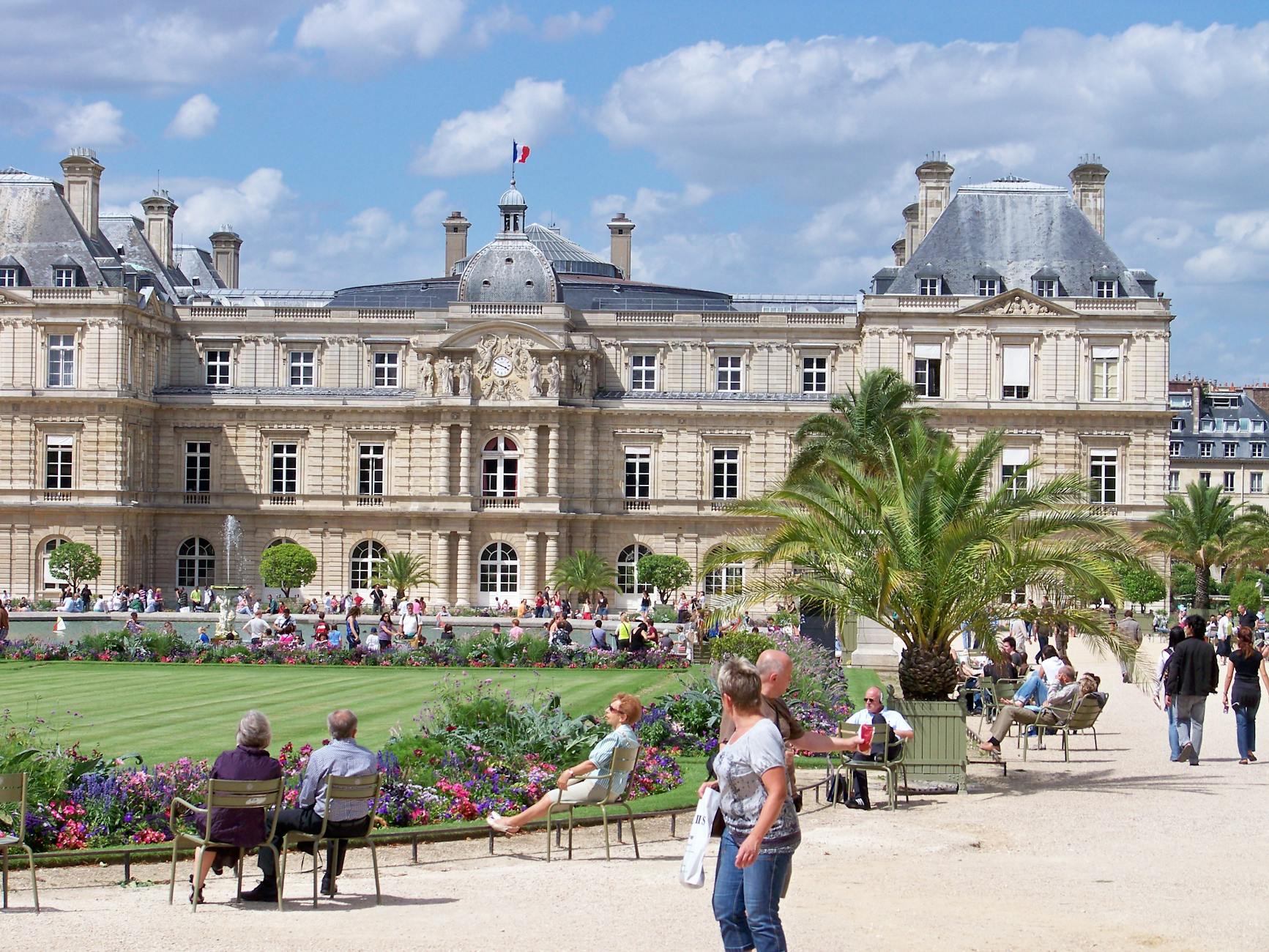
Two locations described in the book as perfect to go to when “hungry”, are the Luxembourg Museum, and the Luxembourg Garden. The Luxembourg Garden is a historic public park that has been in the city since the seventeenth century. The museum has been around since the eighteenth century, and “helps to enrich and increase awareness of France’s national heritage for a wide audience,” according to its website. These are places that really anyone should go to when in Paris, but in reference to the book, are particularly important in understanding Hemingway’s hunger. It is deliberately confusing, whether Hemingway is actually hungry, or it is in reference to his artistic hunger. Either way, it offers an insight into Hemingway’s life: strolling among the garden and looking at art afterward.
Shakespeare and Company
Shakespeare and Company is an independent bookstore in Paris that is referenced again and again in A Moveable Feast. This bookstore, located at 12 rue de l’Odeon in the 20s, is where Hemingway purchased a majority of his books while in Paris. While 12 rue de l’Odeon is no longer where Shakespeare and Company has a bookstore, you can visit the incarnated version near the Seine river and the Notre-Dame cathedral at 37 rue de la Bûcherie.
The Parc des Princes
While Hemingway was in Paris, he had a hobby of watching bicycle races at many different stadiums, but most interestingly at the Parc des Princes. He writes one of my favorite sentences in the entire book, describing when the “great rider Ganay [fell] and [we] heard his skull crumple under the crash helmet as you crack an hard-boiled egg against a stone to peel it on a picnic” (p. 65). I included this stadium specifically, because it is now the official stadium for the city’s futbal (soccer) team Paris Saint-Germain. It is a wonderful place to visit and experience the intense and fun atmosphere of a soccer game abroad, with one of the best teams in the world.
Michaud’s Restaurant
Michaud’s restaurant is seemingly unimportant in A Moveable Feast, and takes up relatively very little space in the book. It is described simply as an “exciting and expensive restaurant” (p. 56) but serves as a backdrop for the most important moment in the book. In that restaurant, Hailey and Hemingway discuss the idea of “hunger.” This, in many ways, frames the entire rest of the book and felt essential to include. Michaud’s is better known as Le Comptoir de Saints-Pères, which offers set breakfasts. One of their specials is called “the Hemingway,” which includes a hot drink, an orange juice, your choice of croissant, tartine, or toast with butter and jam, plus a fruit salad, and scrambled eggs with salmon or bacon, all for €21.80.
Rue de Seine
A personal interest of mine is Hemingway’s relationship with Hadley, his first wife. I had known before reading that Hemingway had four wives across his lifetime, and notoriously used the women he was around. So I was extremely curious to see how Hemingway portrayed his relationship with his first wife in this book. I was surprised to see the intricacy of their relationship. It seemed simple and lovely, but written with so much regret. In a way, their relationship is framed as the perfect thing that was eventually lost or broken, and that pains Hemingway. In my favorite scene between the two, they are in bed theorizing what they could do together during the day. Hadley says,
“Let’s walk down the Rue de Seine and look in all the galleries and in the windows of the shops” (p. 37).
The resulting conversation afterward is so perfect to me, so full of love. It’s unclear whether they actually do go on that walk, but I thought for my final location, I would encourage you to walk this street with someone you love and do the same.
Reflections on the book
I really enjoyed this book, but it is not for everyone. It is boring, since there is very little obvious tension, but so well-written. And the way 1920s Paris is captured, as an artist’s Mecca, as simple and plain living, is very compelling to me. At the heart of this novel is some grand idea about “hunger” that would personally take another re-read for me to completely understand. Rachel Hope Cleves’s essay, aptly named “Hemingway’s Hunger,” has been the most insightful about this. She puts it very simply as “hunger is a positive creating force.” And that is absolutely true in Hemingway’s case. Of course there is more nuance to it, but that is something you will have to explore for yourself. This book felt somewhat similar to the movie Perfect Days, which follows the life of a man who cleans toilets for a living. They both showcase simple living very well, although Perfect Days is much more heart-felt and includes a bit more tension. Personally, I would rate this book a 4 out of 5. But if you find yourself getting bored easily by books, or just want something compelling to drive you forward in a narrative, this book is not that and you might not enjoy it at all.
Hemingway wrote, in a letter to a friend,
“If you are lucky enough to have lived in Paris as a young man, then wherever you go for the rest of your life, it stays with you, for Paris is a moveable feast.”
In its own way, this book makes Paris as portable as Hemingway experienced it. There are so many lovely descriptions on every page that are completely unforgettable. If you want that experience, but you find yourself extremely bored with A Moveable Feast, you should read The Sun Also Rises by Hemingway, which has the same beautiful place-based writing, but a much more compelling story.
Hemingway did an excellent job of noticing the city around him and taking that with him. I hope you do the same if you find yourself in Paris.
Transparency disclosure: Buying through the book links to Amazon on this site could earn Travel Muse Magazine commission, at no cost to you (it comes out of Amazon’s end). Thanks for helping us maintain this site, while also getting a good book to make your travels better!

Leave a Reply