
“Climb the mountains and get their good tidings. Nature’s peace will flow into you as sunshine flows into trees. The winds will blow their own freshness into you and the storms their energy, while cares will drop off like autumn leaves.”

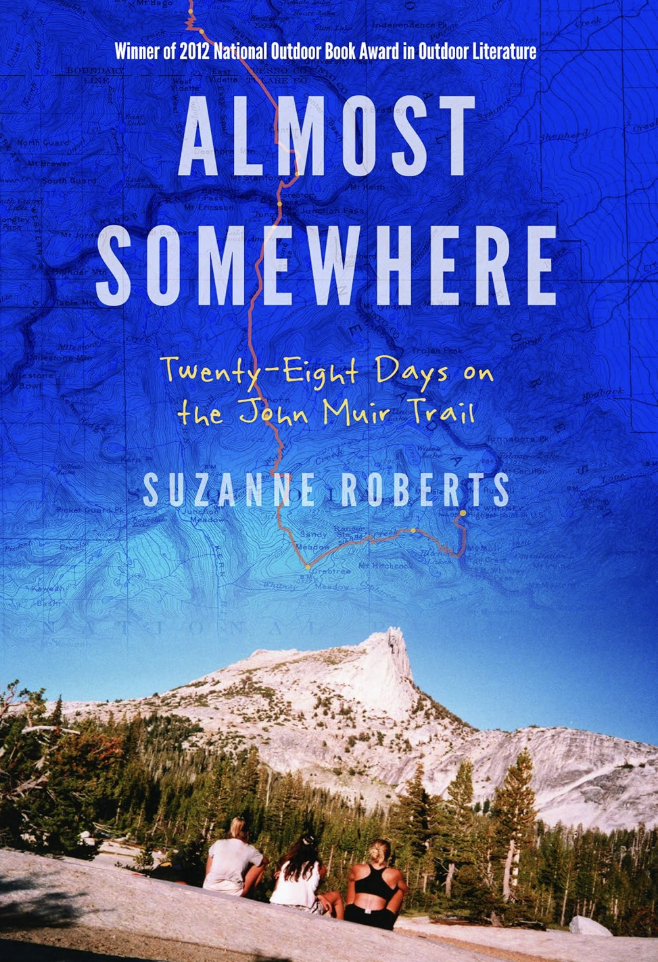
This is one of the many quotes by naturalist John Muir that inspired Suzanne Roberts to hike the John Muir Trail (JMT) in 1993, and eventually to publish her experience in Almost Somewhere. Similarly to reading this quote, reading Almost Somewhere leaves you feeling like wind has just flushed your face, making you feel closer to nature; warmth spreads to your own limbs as you read each chapter.
Set in California’s Sierra Nevada mountains, the memoir tells the story of Roberts’ journey as she tries to find herself in the midst of nature. Reading along with the wonders of the JMT, I found myself wanting to stretch my own face up to the sun to let my cheeks turn red. But in reality, I was slumped over in my bed in the middle of an unforgiving Michigan winter, my seasonal depression begging for the chance to live in this book. I’d never considered backpacking to this caliber before reading this book, but now my curiosity is piqued. Do I have the stamina of body and mind to hike more than 200 miles for a month straight? What would the training be like?
For Roberts, there was none. She hit the trail fresh out of college without preparation or the correct gear. Although transformative and euphoric, the journey was not easy for Roberts by any stretch of the imagination. The trail is daunting, and can even be considered dangerous for inexperienced hikers, as she was. Thankfully, Roberts didn’t make the trek solo, and hiked with her two friends from college, Dionne and Erica. All with varying levels of experience, the women hiked the JMT in its entirety for 211 miles in 28 days.
So why hike the JMT? Where are the most important places to stop? How can one get the Almost Somewhere experience– the one with not only scenic views, but also the personal growth? To help answer these questions, here’s a guide to 10 places on the JMT that are informed by the trail’s highs and lows as noted in the book.
Travel Guide
Starting off with a peak that challenges even experienced hikers, Mt. Whitney is the “tallest mountain in the lower 48 states.” Roberts reaches this peak on day three, where her friend Dionne experiences challenges with altitude sickness, a highly preventable illness that many hikers struggle with as the body tries to adjust to lower oxygen levels. Although undeniably challenging, Mt. Whitney was the women’s first rewarding view on the JMT, described as: “The hills, brown and crumpled like a taffeta dress that had been unfastened, left to drop from the sky, draped into the distant horizon” (p. 31).
Another location that’s a must-see view for hikers is Thousand Island Lake. This hike is relatively easy compared to some of the other peaks on the JMT, but the view is just as rewarding, described by Roberts on day 24 of the hike as “aptly named because of the thousand little islands strewn across the large lake.” (p. 225) Upon arriving here, Roberts and the women feel like they’ve finally received a break from the harsh terrain, and they take time to enjoy the beautiful scenery.
The next place I’ve added is Curry Village Pizza Deck, and you might be wondering why, because the women never stopped at a restaurant on their hike. It’s true that Roberts and her friends didn’t give in and stop for food along the way, but she did mention wanting to in almost every chapter. To honor Roberts’ truly impressive and persistent pizza craving, this pizza spot is a fatigued hiker’s dream in Yosemite National Park.
Another restaurant located in Yosemite is Whitebark. Similar to the pizza deck, the women would’ve loved to stop here to fulfill their comfort food cravings, especially for dessert. With a menu featuring five dessert items, including a New York-style cheesecake, Whitebark is certainly a step up from the no-bake cheesecake that the women enjoyed on their hiking days.
In this area, Yosemite Valley is another significant part of the trail, offering more than just beauty alone. John Muir, the namesake of the JMT, was known as the guardian of Yosemite. Originally visiting the area in 1868 and returning the following year, John Muir worked in Yosemite Valley as a ranch hand and a shepherd, giving him access to the land where he studied plant and animal life. John Muir’s writings, inspired by his time at Yosemite, not only inspired Roberts, but also “a movement to protect not only the beauty of natural areas but their ecological significance.”
Le Conte Canyon, also known as the Golden Staircase, was the last section of the trail finished in 1938 —inspiring both hikers and artists with its beauty. Containing almost 100 switchbacks and an animal-friendly design, Le Conte is considered a “monument to trail-building ingenuity and modern design” that was ahead of its time. It’s named after High Sierra explorer Joseph Le Conte. Inspiring even Roberts’ journals in the book with its magnitude, Le Conte will continue to inspire artists and designers for many years to come.
Muir Pass (named after John Muir) is another location hikers will continue to prioritize in their travels because it contains the Muir Memorial Shelter, and it was recently recognized on the historic register. Reaching the Muir Shelter on day 10 in a haunting chapter titled The Ghost of Muir Pass, the women decide to spend the night in the shelter despite being warned against it. Reading from a plaque on the wall of the shelter: “This building was constructed in 1930 by the Sierra Club in cooperation with the Sierra National Forest and dedicated to the memory of John Muir. The Muir Hut was intended as a temporary shelter for hikers caught in storms on this exposed section of the trail” (p. 105).
After hiking Muir Pass, southbound hikers will be delighted to travel into the glorious Evolution Valley, which encompasses endless beauty and intrigue in its “clear lakes, dwarf meadows, jagged sky-stabbing peaks,” and rich history. Roberts hiked through this location for a few days starting on day 11, expressing feelings of peace and tranquility: “The last light shined a dusty orange in the creek. Everything quiet, everything still” (p. 127).
The second-to-last section built on the JMT was Forester Pass, finished in 1932. Known as an “engineering marvel,” this pass is the only maintained trail that acts as a crossing to the dangerously high Kings-Kern Divide. The creation of Forester pass was long and meticulous, entailing the blasting of sheer granite to carve out the trail. Roberts reached this pass in the early stages of the hike, encountering an unexpected danger on the trail that presented itself within her own group.
Long before the arrival of Europeans in the High Sierra, the land was explored and used for centuries by Native Americans. Tuolumne Meadows was used for trading among various tribes and for hunting advantages using the high peaks. Roberts reaches Tuolumne Meadows on day 26, a very important point in the book, where she faces an urgent challenge and is encouraged to go home. Despite this difficulty she decides to endure, hiking on to the end with Dionne and Erica.
Reflections on the book
As a woman, college student, and inexperienced hiker, I found this book incredibly refreshing. The honesty throughout the book kept me engaged, as well as the individual stories from all of the women.
There is not a lot of literature following women in the outdoors, and I loved that reading this book brought this gender gap to my attention while also nurturing the curious parts of myself that would love to escape into the mountains. I also loved that Roberts and her friends didn’t do a lot of things “correctly.” In a book review from Foreword Books, “Roberts’ narrative is characterized by her refusal to recall blunders with regret. In fact, the decisions that trail experts would most bemoan—carrying a small library of naturalist books over a mountain, hiking in boxers through sleet, simply breaking the rules of the trail—are those which the author recalls most jocularly.”
Almost Somewhere is a great place-based story that piqued my curiosity in both the environment and the plot. Due to the extreme nature of the setting, each of the women faces struggles in the book that they do not encounter in everyday life, pushing both individual and group development.
Suzanne Roberts’ Almost Somewhere healed me in ways I didn’t expect. It urged me to lean more into my female friendships, read more from John Muir, and accept my flawed inner narrator like Roberts did. I would personally rate the book as five stars. It was not the most exciting book, and I wouldn’t recommend it if you’re looking for something that has a lot of plot twists, but I wasn’t looking for something shocking to read. I’m just happy to have found something real. I almost feel like reading along with Roberts’ trail-wandering thoughts taught me how to navigate my own wild thoughts, and how to redirect negative thought patterns back to reality– back to nature, back to endless free-flowing air and sunlight, back to connection and curiosity. This book helped bring me back to the real world.
If you love a story like this one where women navigate their struggles together, you might also like the Netflix original Dead To Me. Although this series doesn’t follow a naturalistic theme, the relationship between the women is similar, as it follows women navigating grief who find support from each other.
Transparency disclosure: Buying through the book links to Amazon on this site could earn Travel Muse Magazine commission, at no cost to you (it comes out of Amazon’s end). Thanks for helping us maintain this site, while also getting a good book to make your travels better!


Leave a Reply