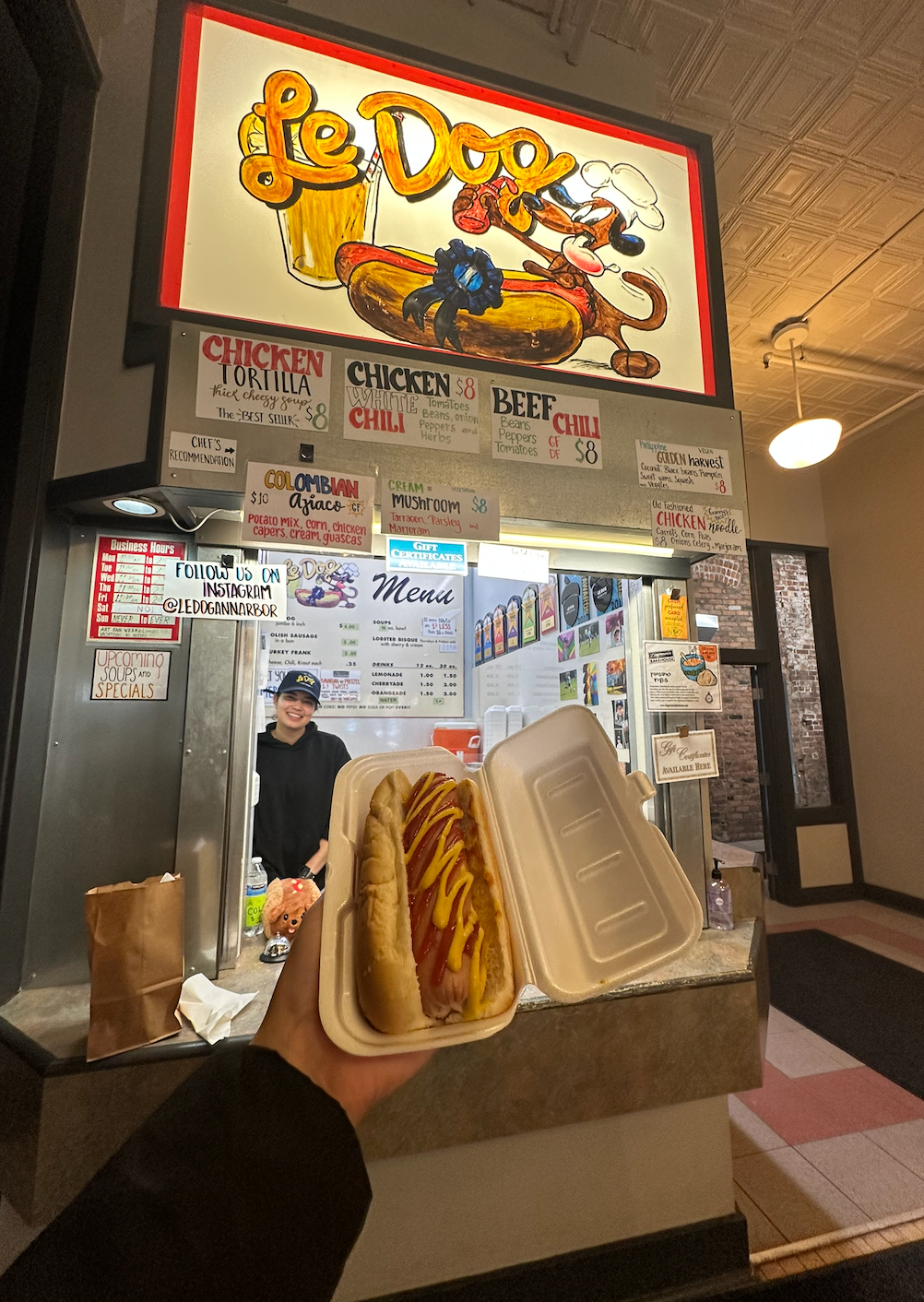
In a college town where restaurants often come and go every four years, Le Dog has quietly stayed the same since 1979. Located inside the historic Pratt Block on Ann Arbor’s Main Street, the small counter-style shop has built its reputation not on reinvention, but on consistency. The entrance is easy to miss. A narrow hallway leads to a counter space that feels preserved. Newspaper clippings, framed awards, and decades-old photos line the walls. A bold sign on the menu reads: “NO COKE. NO PEPSI. NO SODA OR POP. EVER,” making me think of the 1978 Saturday Night Live “Cheezborger” sketch. Whether intentional or not, the phrasing feels like a nod to old-school American counter culture, where the menu is fixed and the rules are clear.
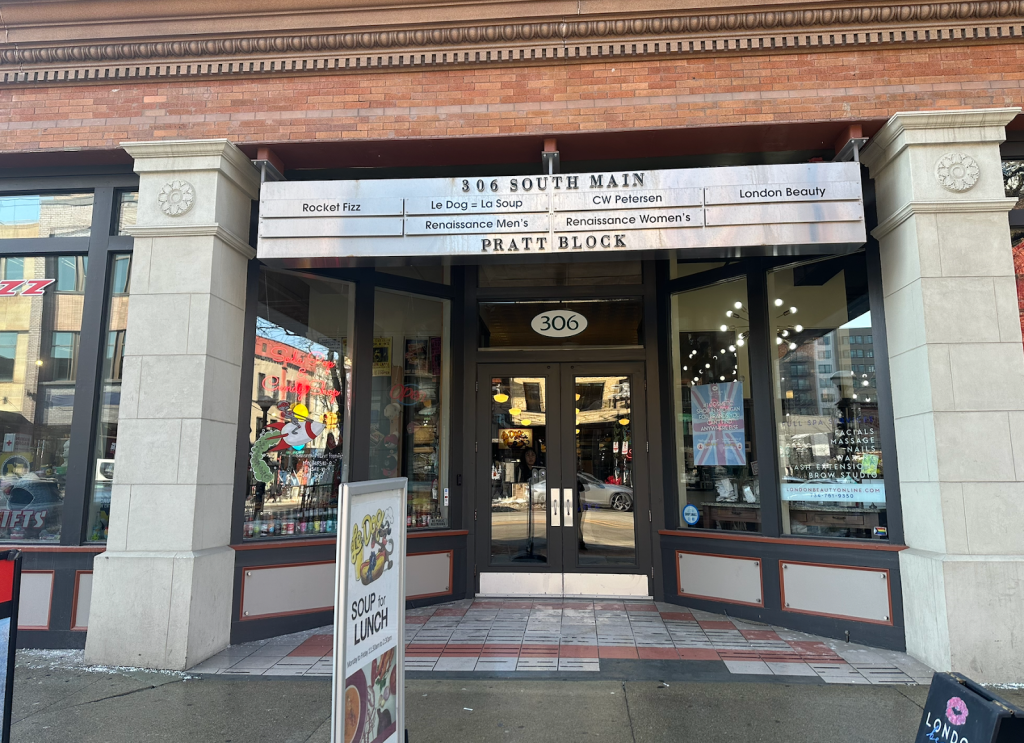
Founded by European immigrants in the late 1970s, Le Dog began as a small Liberty Street stand selling hot dogs and lemonade before soups “soon followed, becoming local legend,” according to the Ann Arbor Observer. The article notes that the shop built early recognition by pairing high-quality sausages with house-made soups, blending American street food and European culinary influence. Even the name reflects that blend. “Le Dog” pairs a French article with an American staple, subtly signaling the European roots behind an otherwise classic menu.
The Soup
Soup is “is probably as old as the history of cooking,” according to Food Timeline, which goes on to say soups evolved according to local ingredients and tastes, becoming staples across cultures, from Russian borscht to Italian minestrone. The word “soup” comes from the Old French soupe, meaning bread soaked in broth, which is appropriate, seeing that the “idea of the modern restaurant industry is said to be based on soup,” given that the word restaurant comes from the French restoratifs, which were soups! What began as sustenance for travelers and laborers eventually became the formal first course on menus today.
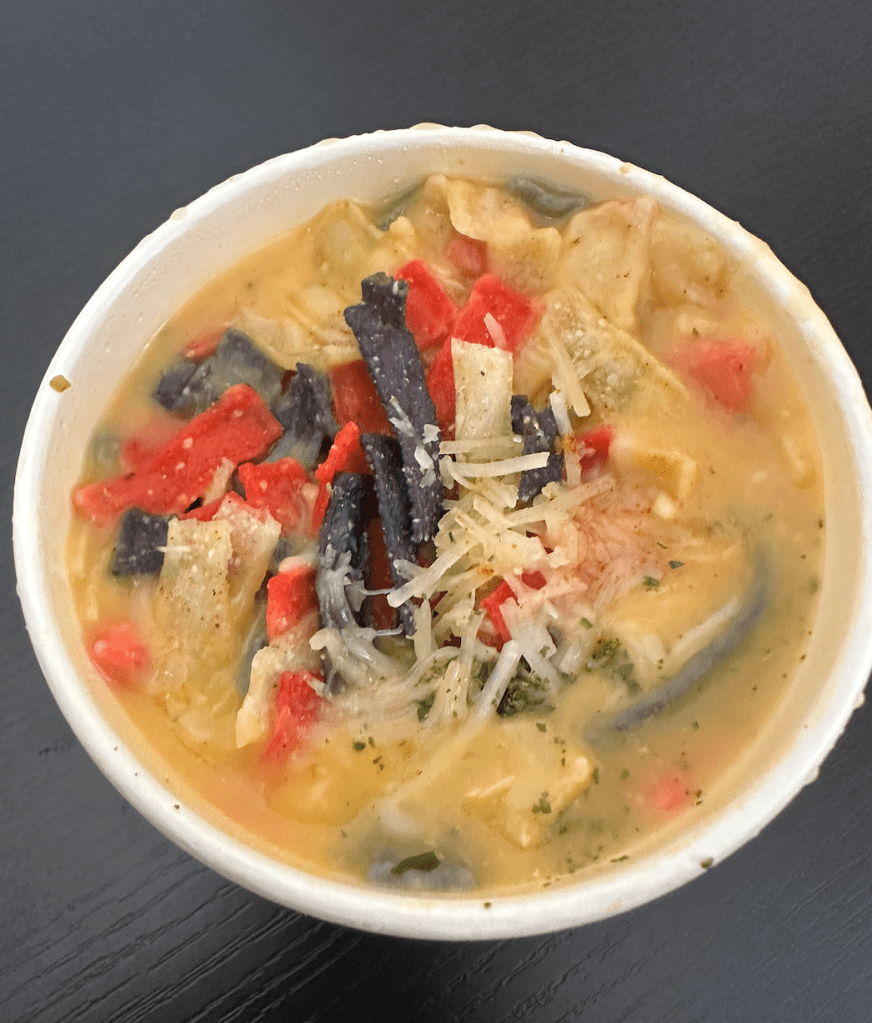
At Le Dog, that long history feels condensed into a paper container. I ordered a 16-ounce chicken tortilla soup. Lobster bisque, one of their most sought-after items, is only served on certain days, which makes it feel more like an event than a permanent menu staple.
What surprised me most was the chicken tortilla soup. It was slightly thicker than a clear broth but not heavy like a cream soup. It had body without feeling dense. The lightly opaque liquid is filled with tender shredded chicken and soft vegetables that hold their shape. Steam rose when I lifted the lid. The warmth felt immediate against the winter air.
I grew up in Romania, where soup is not optional. Lunch begins with soup. Dinner often does too. Even on busy days or holidays, there is soup. Romanian chicken soup is usually clearer and lighter than this tortilla version, but the ritual felt familiar. Holding the warm container between my hands on a cold Ann Arbor afternoon felt grounding in a way I did not expect.
On paper, a hot dog and chicken tortilla soup feel like an unlikely pairing. Somehow, here they work. The snap of the sausage contrasts the warmth of the broth in a way that feels balanced rather than strange. What sounds mismatched ends up satisfying.
The Hot Dog
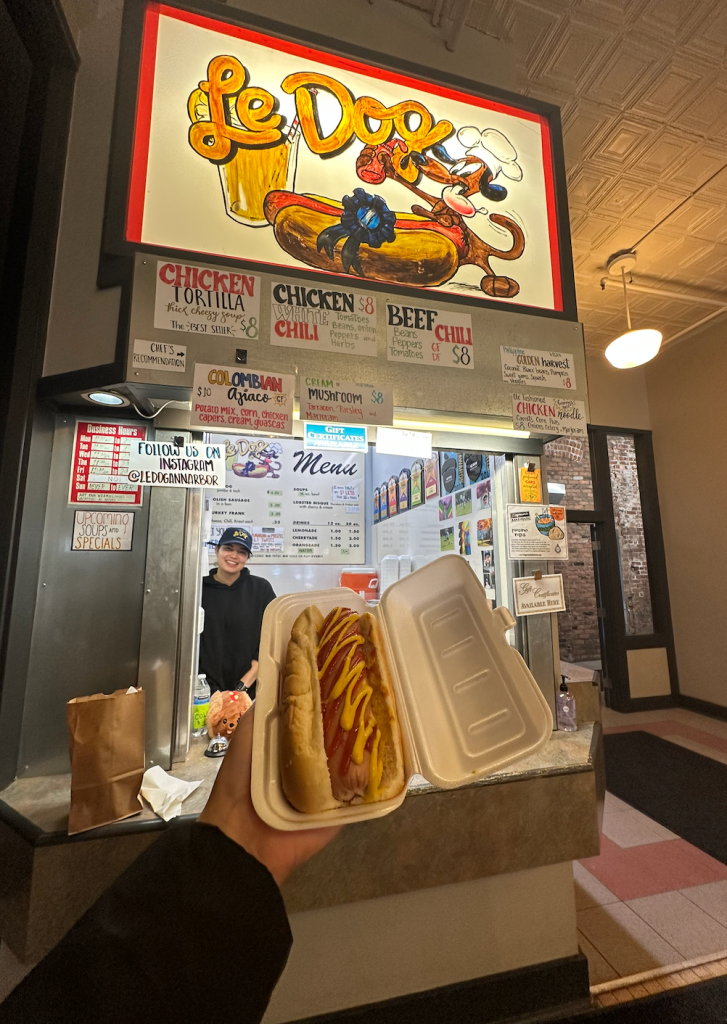
The jumbo hot dog felt distinctly American. I did not grow up eating hot dogs regularly and mostly knew them from movies and television. In Romania, we had sausages, but hot dogs carried a different cultural image. Eating one here did not feel cinematic or symbolic. It felt unfussy and satisfying. The bun compressed slightly under the weight of the savory sausage, and the mustard cut sharply through the saltiness. It was simple food done exceptionally well.
Yet that simplicity carries history. According to the National Hot Dog and Sausage Council, food historian Bruce Kraig, Ph.D., traces the modern hot dogs to German immigrants in the 1800s, who brought their sausage traditions to the United States. Over time, those European sausages evolved into what became an American street food staple. Le Dog’s founders, European immigrants themselves, quietly embodied that culinary exchange. The hot dog may feel quintessentially American, but its roots, like the soups that define this shop, trace back to Europe, back to home.
The Place
Inside the shop, there is no indoor seating, encouraging movement rather than lingering. Orders are called efficiently. Paper lids snap closed. Customers range from University of Michigan students to longtime Ann Arbor residents. The space feels less like a restaurant and more like a ritual stop on the way elsewhere.
For a place that serves something as simple as hot dogs and soup, the experience carries surprising depth. On a cold Michigan afternoon, the warmth of the soup, the snap of the sausage, and the scent of broth rising in the narrow space point to meals that feel reliable rather than flashy. In Ann Arbor, where nearly everything resets every four years, Le Dog simply continues.

 Travel Muse Magazine
Leave a comment