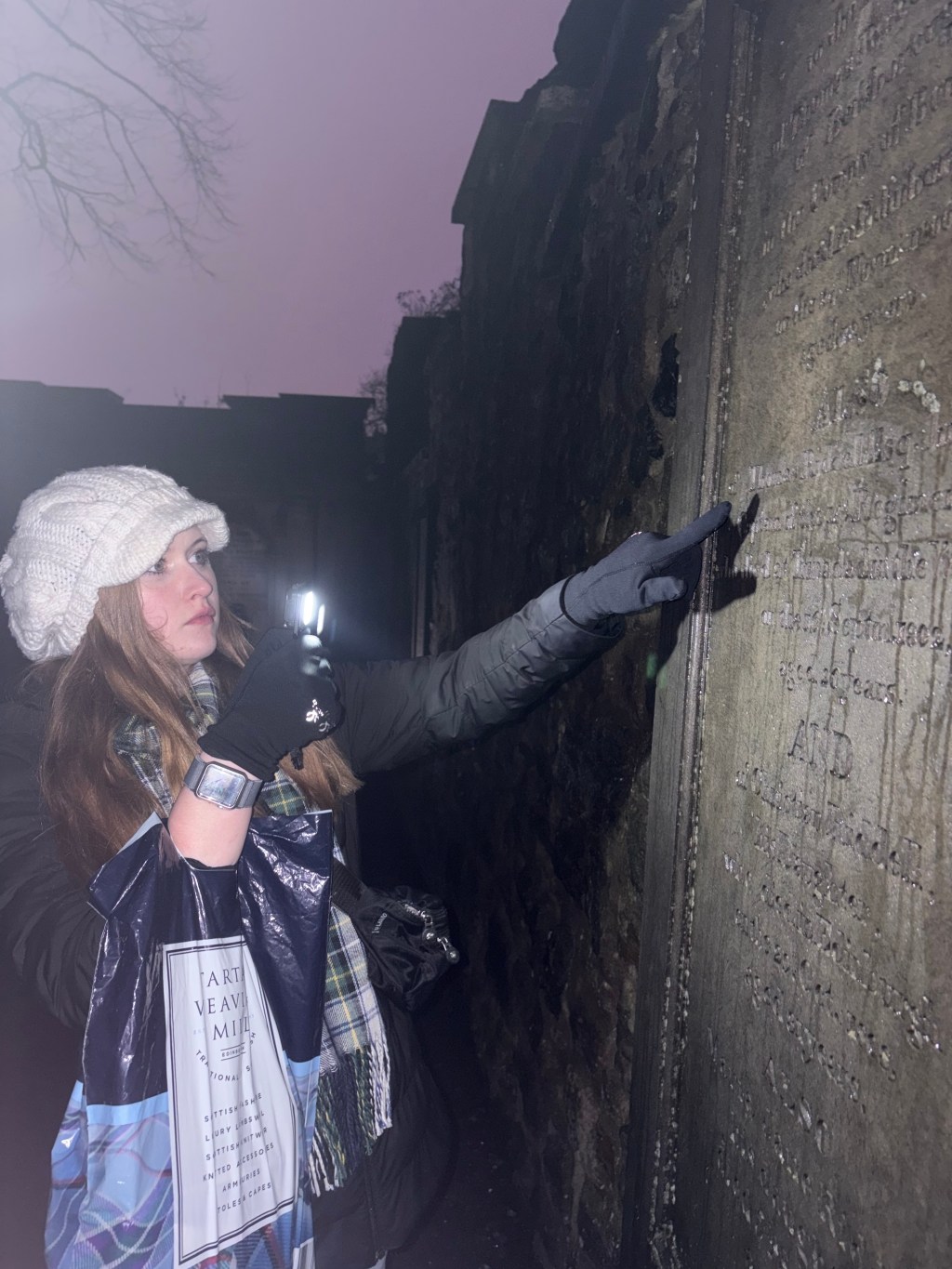
Low clouds hang over the damp night. A mist clings to the trees, particles of moisture illuminated as the castle’s roaming spotlights break through the darkness. This was the setting as I wandered the Greyfriars Kirkyard cemetery in Edinburgh in December on the hunt for the real Tom Riddle’s grave.
Yes, I’m talking about the bad guy from Harry Potter, back when he was to be named, before becoming Voldemort. It was an adventure, one that I hadn’t thought about taking before we arrived in Scotland’s capital city. Our flashlights on our phones sweeping over the names of people who once too walked these same ancient streets, my three teens, my husband, and I were determined to solve the mystery: Would it really be here, just because it’s marked on Apple Maps? Little did we know that this odd detour would turn out to be one of the most unexpected yet dare I say enjoyable experiences that I think back on fondly a month later.
It may seem macabre, but writers have long been strolling graveyards looking for inspiration… and we were too, my kids all fans of the Harry Potter books and movies since they were little. We were hoping for a peak into what had inspired JK Rowling when writing the famed series while she lived in Edinburgh.
Tom Riddle’s grave wasn’t high up on our list of “must do’s” in Edinburgh. We didn’t have a lot of time this visit to Edinburgh (one of our favorite cities anywhere) and I wouldn’t have thought this was something to give our precious day to. We headed to Greyfriars Kirkyard originally to see the legendary Greyfriars Bobby.
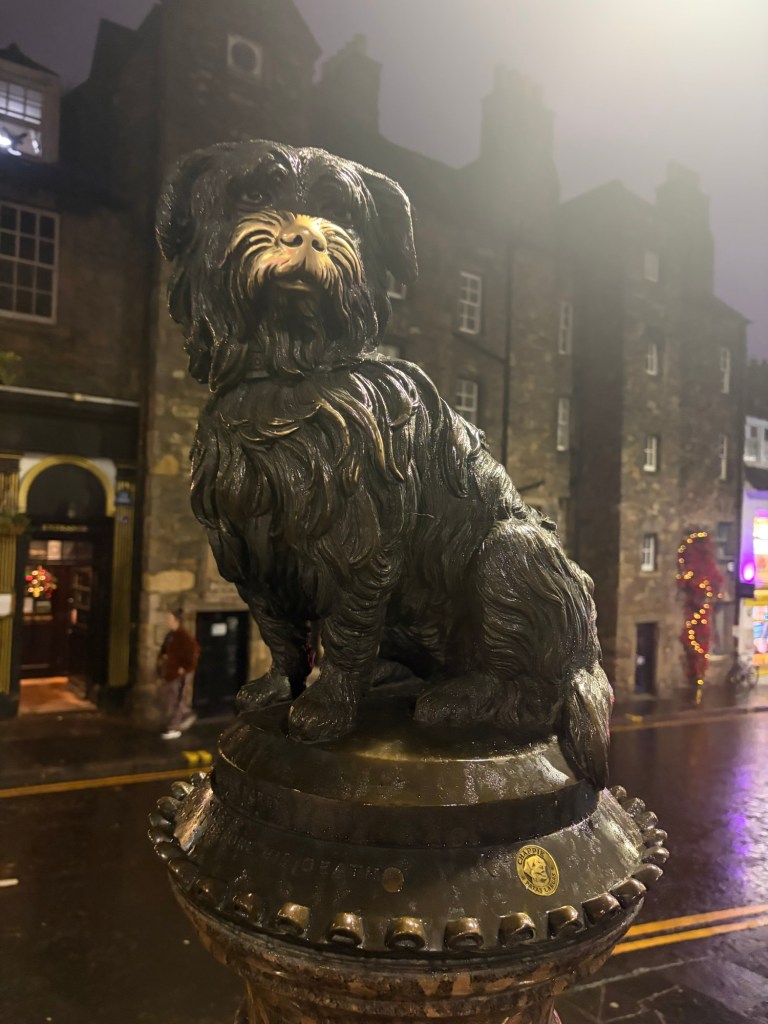
Let me pause here to explain a few things… First, a kirk is what a church is called in Scotland and a kirkyard is another name for a graveyard. Bobby was the name of a faithful dog of a popular Edinburgh police night watchman in the mid 1800s, who turned into a local legend. (The pup refused to leave the side of his owner’s grave for 14 years, the townsfolk adopting the dog as he stayed watch day in-and-out. They erected a statue of the dog to pay their respects, noting, “Let his loyalty and devotion be a lesson to us all,” as the plaque on the statue says. Read the whole tale at Historic UK.) This is a uniquely Edinburgh thing of pride and the dog is really cute. Plus rubbing the statue is said to be lucky… all right down my kids’ alley. My husband and I had visited the dog before, when we were last here in Scotland to get married some 20-years-back. So we felt it was a must-see for the whole fam.
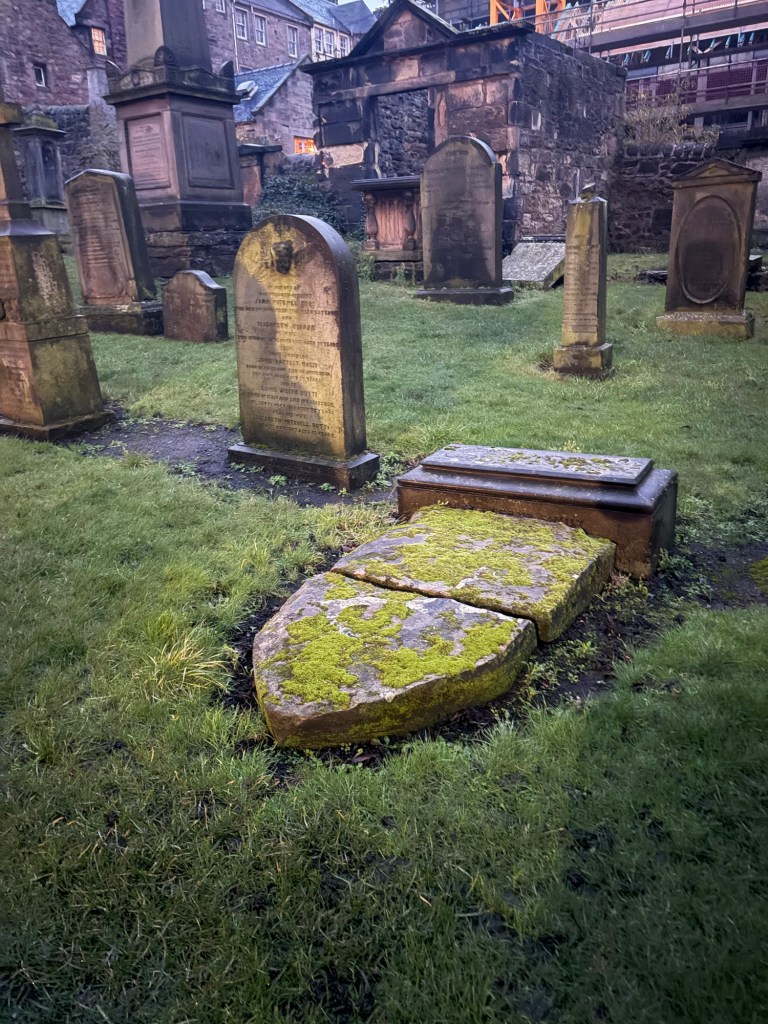
So there we were admiring Bobby’s statue, when we thought, let’s go in the graveyard. I’d seen Tom Riddle’s gave marked on the map earlier when plotting our course here from another graveyard – Canongate Kirkyard, where our “history of Edinburgh” walking tour ended. That cemetery was featured on the tour because it is where Charles Dickens is said to have been inspired with the name Scrooge for his famous A Christmas Carol novel (read more about that bit of history here). Both cemeteries are famous places in Edinburgh, where lots of “notable” people have been laid to rest for hundreds of years.
The night was right for exploring a supposedly haunted graveyard, rain having left such a dampness to the air that it felt heavy while simultaneously appearing to glow with the Christmas lights all around. Perfect thing to do right before dinner, so why not. And I’m so glad we did.
It’s interesting to walk through history of a place in such a way, looking at the names of people who came before, wondering what they did, what they were like, what life was like when their families stood right here honoring their lives. The Greyfriars church’s stained glass windows were beautifully illuminated too, standing watch tall in the night sky over the people buried here.
We weren’t alone in our search for Tom Riddle’s tombstone. We passed a young couple also on the lookout and two young women, phones out on the search. It may seem like it would be easy to find a grave marked on a map. But it wasn’t. There aren’t lights on the paths and due to the age of the cemetery, the tombstones aren’t all in the best condition. Rain soaked the stones, making them have light and dark patches, which made reading names even more difficult.
But that’s part of the fun too: the hunt. There’s also a tall wall that seems to be the back of the graveyard, until, that is, you find the opening that leads to another section just behind. And low and behold, small chains began to edge the dirt pathway. I knew we must be getting close, the Edinburgh City Council, which owns the property, wanting to keep tourists on the correct paths, not stomping on delicate stones.
Our feet crunching on gravel now when suddenly, a screech breaks the silence of the night.
“I found it! It’s here,” my 18-year-old daughter yells out with pride. “I found Tom Riddle!”
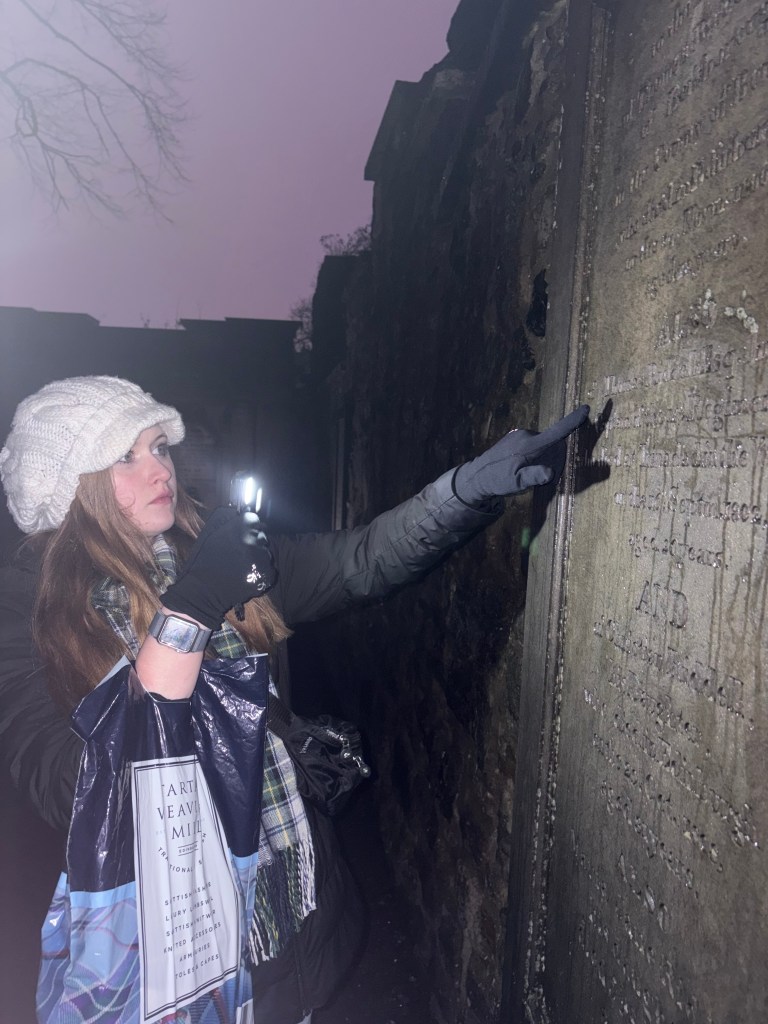
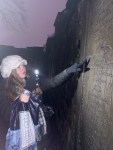
Soon, the rest of my family hurries over, along with the other night wanderers. She points to the words on the stone mounted on the wall, her flashlight tracing the old lettered grooves. We did it. There was a satisfaction in the small victory. A unification of strangers gathered around the grave of a man none of us know, except by name.
Or, by almost name.
You see, the grave is actually that of Thomas Riddell, not Riddle. Riddell “was a general, died on 24 November 1806 at the age of 72,” says the BBC. The website Archeology Scotland adds that Riddell is linked to the slave trade, a truly dark time and seemingly perfect inspiration for a character that embodies evil.
Greyfriars Kirk’s website says they have “other headstones… said to have played into the names for characters – there is a Moodie (Alastor Moody), Scrymgeour (Rufus Scrimgeour), Cruikshanks (not quite spelled the same as the famous cat!)” and even Potters. Plus there’s a McGonagall (who was known as the “world’s worst poet”). The church states that JK Rowling has admitted that the graveyard “subconsciously inspired her writing.”
“Cemeteries have become such an ingrained part of the human experience that they have become part of our lives in literature and art,” according to an article by Legacy Headstones. Plus, they have a certain gravitas, a weight that carries with it deep thinking while walking, something that writers need as they’re working on books.
So it makes a kind of sense that both Charles Dickens and JK Rowling found inspiration here. And so have others, including Neil Gaiman, who wrote on his Tumblr, “The graveyard in The Graveyard Book was built up equally from Highgate Cemetery West, Abney Park in Stoke Newington, and a little bit from Glasgow Necropolis.”
“A massive influence on twentieth century vampire lore, Anne Rice” was influenced by New Orleans “cities of the dead,” including St. Louis Cemetery No. 1, according to the graveyard’s official tour company.
It’s even “a thing” to go on literary tourism jaunts to other graveyards. Check out this article by Bustle with ideas for 10 cemeteries to visit the final resting places of famous writers around the world.
- Museum Cafés for Art Lovers: London to Lisbon, Paris to Ann Arbor

- Finding Tom Riddle’s Grave in Edinburgh (& Other Real Graveyards That Have Inspired Popular Books)
- 6 Amsterdam Must-Visit Places Along One Tiny Street You Likely Won’t See on Any Other Guide – But Will Love!

- The Call of Amsterdam & Why You Should Go, Despite Overtourism (& How to not be Part of the Problem)

- Literary Travel Guide to Pont-Aven, france inspired by Jean-Luc Bannalec’s “Death in Brittany” novel

- Review: Dan Brown’s The Secret of Secrets


 Travel Muse Magazine
Leave a comment