
From page one, I was smitten with Jean-Luc Bannalec’s Death in Brittany novel (2012). To be frank, I’d never heard of this book, much less this series starring French police commissaire Georges Dupin, until the day I laid eyes on it in my local library’s book sale. It’s like it was waiting for me, among the piles of books looking for new homes. My daughter picked it up and said, “This looks like something you’d like.” I opened it up, read page one, and immediately put in in my purchase pile. I left the library with 15 new-to-me books that day (for a total cost of $8!!) and immediately cracked this one open. Days later, I found myself researching the Brittany region of France, so beloved by the author, his passion flew thru time and space right into my heart, now dreaming of the day I’ll get to go see it myself.
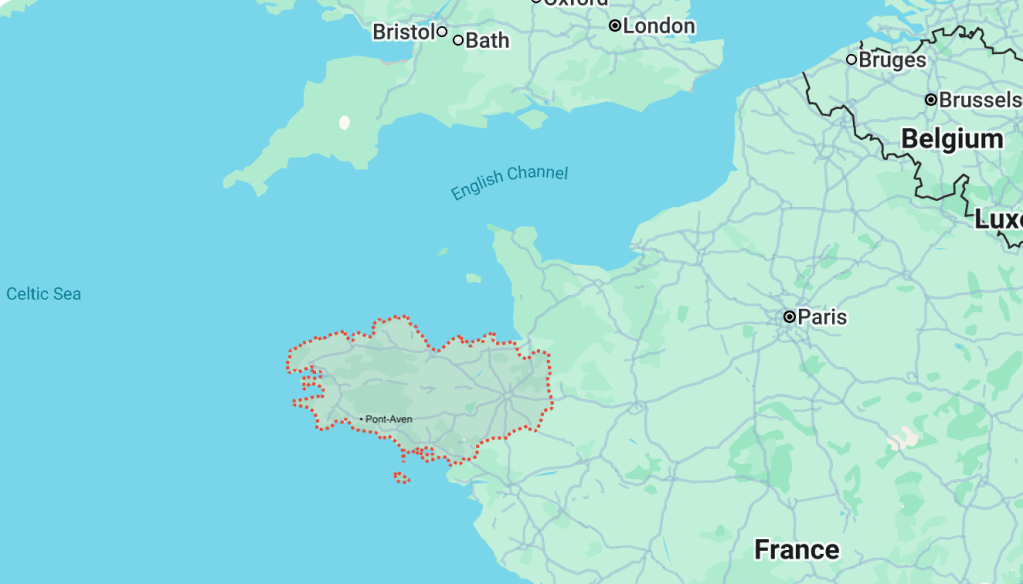
Brittany is the western-most part of France and a long-time holdout to its own Celtic-rooted culture, uniquely distinctive from the rest of the nation, only becoming “a part of France since 1532,” according to the novel (p.74). Until reading this book, I had no idea how much I needed to go here. But I do. No doubt. It is a place of magical light that has been inspiring artists for centuries with “2,200 hours of sunshine per year” (p.189). Bannalec enchants readers with descriptions like this one:
“As evening came on, the light became more and more bewitching. The colours of witchcraft: everything shone brightly, warm, soft and golden… Things weren’t simply lit up: they radiated light from within themselves. Dupin had never seen this kind of light anywhere else in the world, only in Brittany. He was sure this must have been one of the main reasons the painters came here” (p. 76).
Brittany gave itself the nickname “Le Pouldu” (or in English: “The Artists’ Path” and in Breton-Celtic “Poull du”) because of “so many painters in Brittany, in so many different towns,” says Bannalec (p. 281). Among the greats who painted here: Claude Monet in Belle-île, Pablo Picasso in Villa Beauregard, Maurice Denis in Ploumanac’h, and Paul Gauguin in Pont-Aven, a focal point of this art-enriched mystery, in fact!
Jean-Luc Bannalec (aka Jörg Bong), the author of this book (which is the first in a whopping 14 novel-series, with the newest – the 11th in English- hitting bookstores in 2026), is clearly in love with this part of the world. And he spreads his joy for his adopted home on just about every page. According to Goodreads, he “divides his time between Germany and coastal Brittany, France. Death in Brittany, the first case for Commissaire Dupin, was published in German in March 2012 and sold 600,000 copies, spending many months on the bestseller list. It has been sold into 14 countries.” Yeah, it really is that good and I hope there’ll be a TV series heading our way at some point. But only if they really shoot it here. And why not, with the success of HBO’s White Lotus series, this is sure to also be beloved by viewers, just like readers.
Here, then, is a “top 10” guide to visiting the real-life Pont-Aven, Bretagne (the Breton-French name for Brittany) the center of the action in Bannalec’s first novel, where “You found yourself inside [the landscapes of Gauguin, Laval, Bernard]. Very little has changed here in over the last hundred years. Dupin found it astonishing how realistic the paintings seemed once you were here. They were more accurate than any photograph” (p.279).
Art is at the heart of this book, specifically the famed Paul Gauguin who lived here at several points in his life and started a legendary art school here in the late 1800s. So one must visit the Musée de Pont-Aven, which itself is featured in the novel. While the hotel “Central” is a fictional place made up for the novel, Julia Guillou’s Hôtel des Voyageurs aka Hotel Julia is the repurposed home of the museum here, just like depicted in the novel.
Another real, one-time hotel in Pont-Aven that famous artists who came to school here liked to stay at was The Pension Gloanec, according to Musée de Pont-Aven. This is the real-life hotel that gave inspiration to Bannalec’s Hotel Central in the novel. While it is no longer a hotel, you can still visit it – as it’s now a bookshop! Pension Gloanec is located on none other than Place Gauguin, in the heart of town. Here you’ll find a room named for artist Xavier Grall with his mementos featured, as well as another exhibition space that was used at one point by Paul Gauguin, Emile Bernard, Paul Sérusier, and Charles Laval, now open for meetings and gatherings.
“In Pont-Aven it was the river, moist rich earth, hay, trees, woods, the valley and shadows, melancholy fog… ‘Land of Forests,’” Bannalec says (p.52). That river at the heart of this place: the Aven. “As you stroll along the ria, going over the footbridges, it’s easy to imagine why the artists were fascinated by the poetry of the landscapes and the luminosity of the little port,” is how Brittany’s tourism website describes this picturesque waterway. Bannalec adds that there are “some dramatic rapids and waterfalls. You could hear the sound of the falling water all over Pont-Aven” (p. 121).
Along the Aven’s banks, you’ll find “The Bois D’Amour” (aka the “Wood of Love”), a “hotspot of inspiration for the artists staying in Pont-Aven. Nowadays, this out of time place offers a nice walk in the nature, right by the city center,” says the DeConcarneauAPontAven.com, the office of tourism for the villages in the area. Bannalec describes “the landscape” here “more and more enchanting as the narrow little streets at the edge of Pont-Aven [give] way to thick woodland” (p.249)… “enchanted forests of oak and beech, full of mistletoe, moss, and ivy” (p.271).
Plage Tahiti (aka Raguenez beach) is “Dupin’s favorite beach” with “blue-green water” and “fine, dazzling white sand” that looks “just like a bay in the South Seas” (p. 174). According to the Bretagne tourism website, this is a blue flag beach and “considered the most beautiful beach in Névez.”
Just down the coast from Tahiti Beach “amongst the old dunes” is the Ar Men Du, “a pretty little hotel…” that “had the best restaurant on the coast. This was a special place. Here, in Finistère, there were a few spots where you could really feel it: the edge of the world. Yes, this is where the world ended, on this craggy, wild ledge. There was nothing but endless ocean in front of you, an expanse so large that you couldn’t see it all – but you could definitely feel it” (p. 179). That’s how Bannalec describes this gem of a place, complete with a Michelin-starred restaurant, that makes me want to book a flight and a room today.
L’Amiral – This is the favorite eatery of the main character of this novel, police commissaire Georges Dupin. It’s where the character gets his daily morning café or three and his beloved dinner of entrecôte (a ribeye-like cut of steak). L’Amiral was also favorited by the Belgium writer Georges Simenon, who also wrote a famous detective series set here.
Moulin de Rosmadec, “which had been renowned throughout Pont-Aven and the surrounding area for twenty years” (p. 125) is a Michelin-starred restaurant still thriving along the Aven river. The moulin, which means mill, is still a focal point here, though now decor, paying homage to this historical important part of the area’s history. As the restaurant’s website says, “The small town was, in fact, known for its many flour mills before becoming the famous City of Painters.” In the book, the “fruits de mer – the palourdes grises” are recommended as “the best mussels in all of Brittany” (p.125).
Concarneau (Konk-Kerne in the Breton dialect), where Commissaire Dupin calls home, is a short drive from Pont-Aven and heavily featured in the novel. Bannalec describes his love for “this little town,” saying his main character “knew of few places in the world where you could breathe so easily or, as silly as it might sound, feel so free. On days like this, the horizon was practically endless, as boundless as paradise, everything peaceful and clear” (p. 95). He goes on, “but the most beautiful thing about the town was the mood it put you in. And this mood – it was the sea itself.” The essence of Concarneau is in the air, he says. “Inhale in Cancarneau and you tasted salt, iodine, seaweed, mussels in every breath, like a distillation of the entire endless expanse of the Atlantic, brightness and light” (p. 52). Let’s go! I’ll meet you there ASAP.
Festival des Filets Bleus “showcases the richness and diversity of Brittany’s vibrant culture,” says the festival’s website. Created in 1905, the annual event in Concarneau is peripheral to the action in the novel, creating problems for the police chief, as he navigates the traffic that comes with it.
I thoroughly enjoyed Death in Brittany, gave it a five-star rating on Goodreads, and immediately got book two of the series, which I’m reading now. That one is set just off the coast in the Glénan Archipelago, just over ten nautical miles from mainland France, known as the French Caribbean. I’m 80-percent in and planning on reading book three next!
While researching this region for the above article, I also enjoyed these two articles by other travel blogs:
- “Savoring Life in Pont-Aven—The City of Artists” by The Artsy Traveler
- “Take a Walk Through Pont-Aven, a Giverny Alternative” by Travel on the Reg
…as well as these art history-realted pieces:
- “In the footsteps of painters in Brittany” from Brittany’s tourism website
- “Paul Gauguin, the Pont-Aven School and the power of ‘wild and primitive’ Brittany” by the famed art sellers Christie’s Auction House
- The Musée de Pont-Aven’s website home page
- The Prints of the Pont-Aven School: Gauguin and his circle in Brittany by Caroline Boyle-Turner for the Smithsonian Institution Traveling Exhibition Service and held online by the MoMa in NYC.
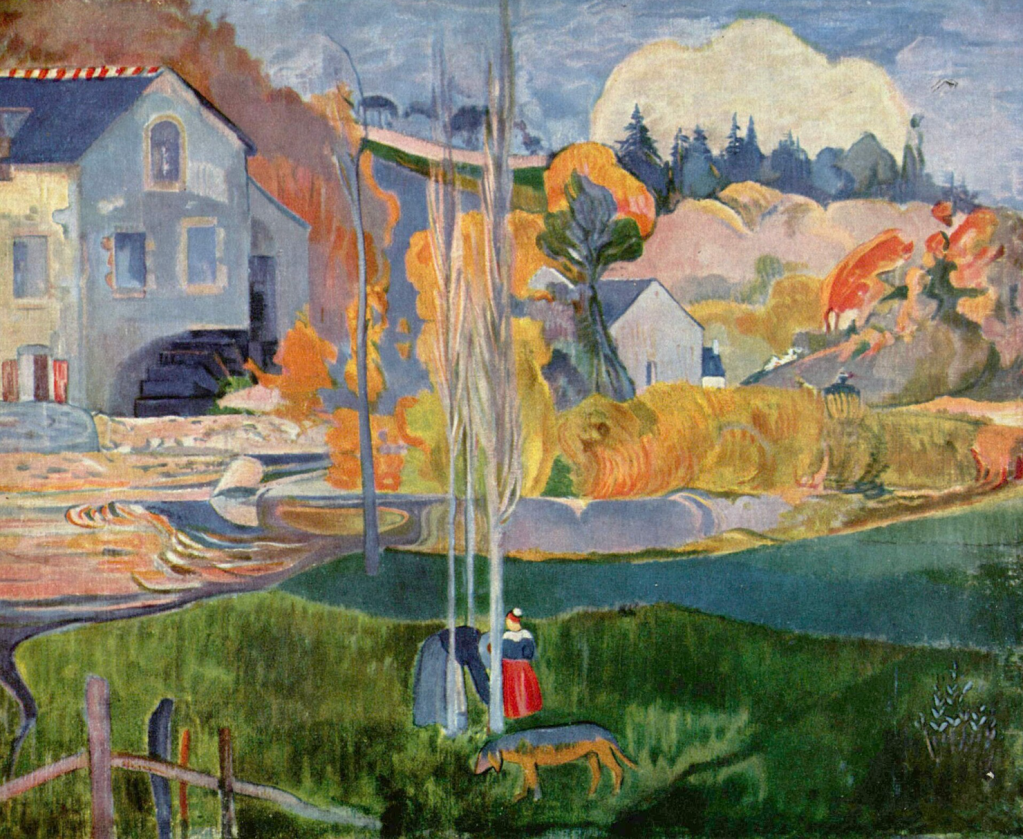
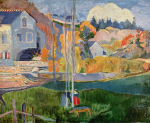
Cover art image (at top of this post): Paysage de Bretagne. Le moulin David. (English: Landscape of Brittany. David’s Mill), of a watermill in Pont-Aven, by Paul Gauguin, 1894, Musée d’Orsay, Paris. Image in the public domain.
Transparency disclosure: Buying through the book links to Amazon in the above piece could (hopefully) earn us commission on these products, at no cost to you (it comes out of Amazon’s end). It’s not a lot of $$ (sadly) but we use it to maintain this site. Thanks for helping us while also getting cool stuff to make your travels better!
- More than a meal: The spirit of Chapalas

- Museum Cafés for Art Lovers: London to Lisbon, Paris to Ann Arbor
- Finding Tom Riddle’s Grave in Edinburgh (& Other Real Graveyards That Have Inspired Popular Books)
- 6 Amsterdam Must-Visit Places Along One Tiny Street You Likely Won’t See on Any Other Guide – But Will Love!
- The Call of Amsterdam & Why You Should Go, Despite Overtourism (& How to not be Part of the Problem)
- Literary Travel Guide to Pont-Aven, france inspired by Jean-Luc Bannalec’s “Death in Brittany” novel

 Travel Muse Magazine

Leave a comment